
Remanufacturing: From Option to Expectation
In today's aftermarket, most purchasing decisions begin with the same questions: What does it cost? Is it available? Will it perform?
Remanufacturing answers all three: Competitively priced. Readily available. Proven to meet performance specifications.
But if remanufacturing is only evaluated on those terms, we are underselling it. Because the real opportunity is not just to offer remanufactured products—it is to create a market where they are expected. Where customers, distributors and decision-makers across the value chain do not ask if a remanufactured option exists—they ask for it by name.
A Unified Understanding Starts with Definition
The aftermarket cannot build preference without first building clarity. Therefore, to move remanufacturing from option to expectation, we must speak with a unified voice about what it is and what it is not, starting with the global definition.
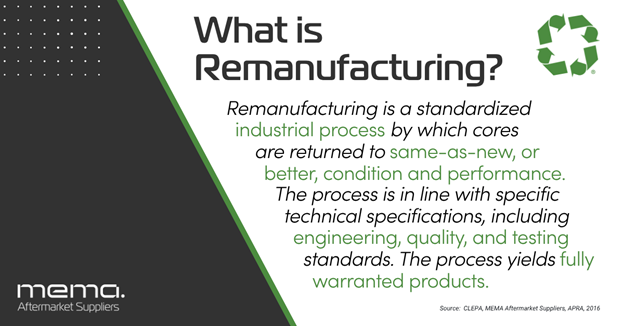
Remanufacturing is a standardized industrial process by which cores are returned to same-as-new (or better!) condition and performance. It follows specific technical specifications, including engineering, quality and testing standards, and yields fully warranted products.
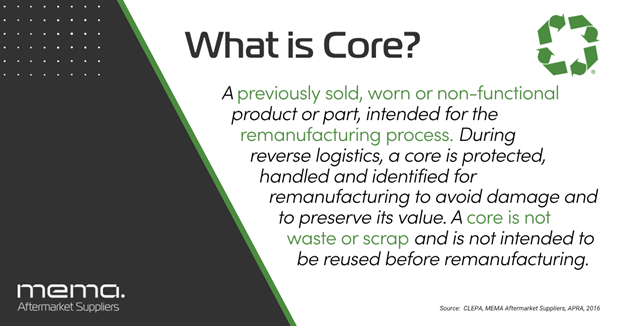
A core is a previously sold, worn or non-functional product or part intended for the remanufacturing process. It is protected, handled and identified to preserve its value throughout reverse logistics.
A core is not waste.
It is not scrap.
It is not simply something "used."
It is a valuable asset at the beginning of its next lifecycle.
Language matters here because it defines value. When we describe cores and remanufacturing with precision, we reinforce the rigor of the process and the quality of the products.
Building Toward Preference

The aftermarket already recognizes that remanufacturing delivers on cost, availability and performance. The next step is ensuring the entire value chain understands what else it delivers.
- Remanufacturing extends the life of equipment.
- It lowers total cost of ownership over time.
- It incorporates engineering improvements that enhance performance.
- It supports more resilient, localized supply strategies.
And critically, it preserves the value already built into a product, keeping resources in the market and in motion rather than pushing them prematurely toward material recovery or disposal.
Within this continuous loop, remanufacturing holds a distinct role. It retains performance—not just material. It sustains value—not just volume.
This is why remanufacturing is not only a smart choice. It is the right one.
A Call to Action: Align, Educate, Advocate
Creating a market where remanufacturing is expected will not happen passively. It requires action across the industry.
- Align – Use consistent, precise language when describing remanufacturing and cores. Reinforce the definition in every product description, sales conversation and technical document.
- Educate – Ensure customers, partners, and internal teams understand the full value of remanufacturing, beyond cost and availability. Make the process, performance and benefits clear and repeatable.
- Advocate – Promote remanufacturing as a preferred solution. Position it not as an alternative, but as a deliberate, high-value choice within the circular economy.
The Future We Are Building
A stronger aftermarket is one where value is not discarded prematurely, performance and sustainability work together and remanufacturing is not the second option, but the first request.
"I'll take the reman option."
That is not just a shift in language.
It is a shift in expectation.
And it starts with all of us.